Hi, I'm Patrick.

I take products from zero to one.

Most recently I shipped TakeUp Demand Generation solo: a five-word brief to a working AI marketing platform in five months.

At ServiceNow's NowX venture studio I helped take seven ventures from concept to internal funding; one graduated in three months. Earlier, three more inside Iron Mountain's innovation lab.

Now building Stryder, an app that helps solo founders know what to do next, as a fully functional portfolio piece to illustrate my skillset.

Open to product lead, venture studio, and entrepreneur-in-residence roles.

patrickhealyid@gmail.com

TakeUp Demand Generation

TakeUp's second product. An AI-first demand-generation platform for independent hotels, built in five months.

TakeUpHead of ProductNov 2025 – Apr 2026Solo build

Solo, brief to MVP
5 months
Under contractor budget
$250K
Customers booked
3
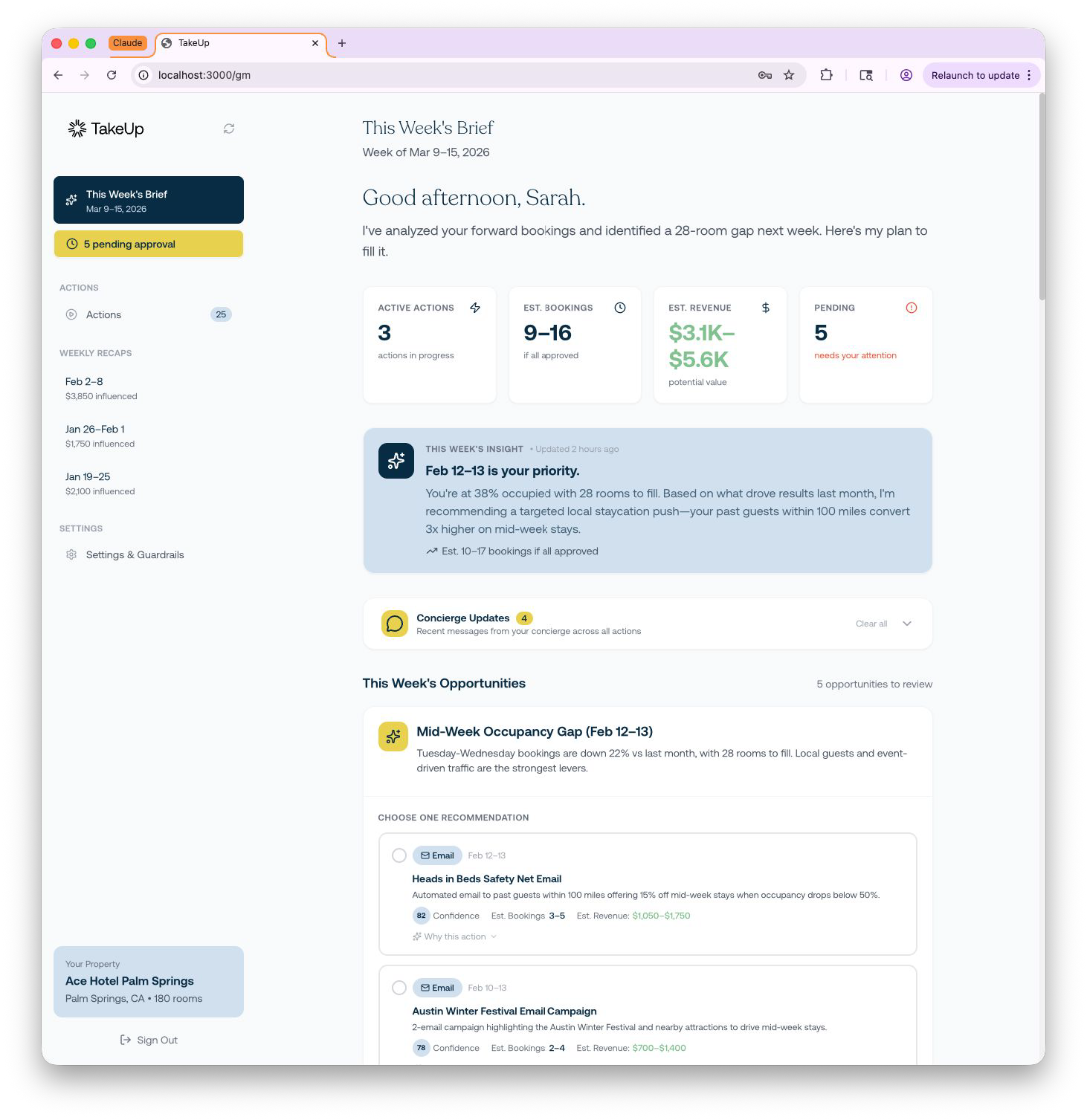
TakeUp Demand Generation GM dashboard showing the weekly brief, ranked opportunities, and one-tap approvals.
Fig. 1.1The GM dashboard: the week's recommended actions, ready to approve.

When I joined TakeUp, they were known for helping independent hotels optimize their pricing. I was the first product manager the company ever hired. My mandate was to lead TakeUp's second product, an AI-first application that generates demand for hotel rooms when organic demand is low. I scoped it from a five-word brief and shipped the MVP in five months.

View the live demo

How it shipped in five months.

A five-word brief became twelve product concepts, then six tested with buyers and users, then one MVP scope. The plan on the table called for three months and two contractors. Instead, I built and shipped the MVP in five months, solo, and replaced roughly $250,000 of planned contractor spend in the process. The two decks below are the actual deliverables: the scope proposal that set the build, and the pitch I used to sell to potential design partners.

Concept test results and MVP scope

The proposal I presented to decide what to build: concept testing across six ideas, the GM research, the recommended hybrid MVP, and the in/out scope.

Loading deck

Design-partner pitch

The pitch sent to prospective hotel design partners once the MVP was live.

Loading deck

Fig. 1.2The concept-test and MVP-scope proposal, and the design-partner pitch.

What I built, and the decisions under it.

The product turns a week of market signals into three to five marketing actions a hotel GM can approve in minutes, then runs them through a human concierge. Two calls made a one-person team viable. First, a multi-model intelligence layer that sends each task to whichever model handles it best. Second, a config-driven engine where new action types are added as data, not code, so the product could grow without a release for every change.

Closed-loopAI engineTakeUp Demand Generation · solo · 5 months
Signals
14 sources
6 categories
+ EXPAND
Intelligence
4 LLMs · 25 SOPs
prompt assembly · guardrails
+ EXPAND
Output
22 marketing actions
6 categories
+ EXPAND
Results
30+ metrics
8 platform families
+ EXPAND
Outcomes re-injected as guardrailsTap any station to expand
Fig. 1.3The closed-loop engine. Tap any stage to expand it.

What it became before it wound down.

Three of six warm prospects converted, alongside three of thirty-four cold leads. Three customers were booked when TakeUp wound down in April 2026. The MVP shipped two role-separated surfaces, a GM dashboard and a Concierge console, plus token-based guest access, and a closed learning loop that fed each week's results back into the next week's recommendations.
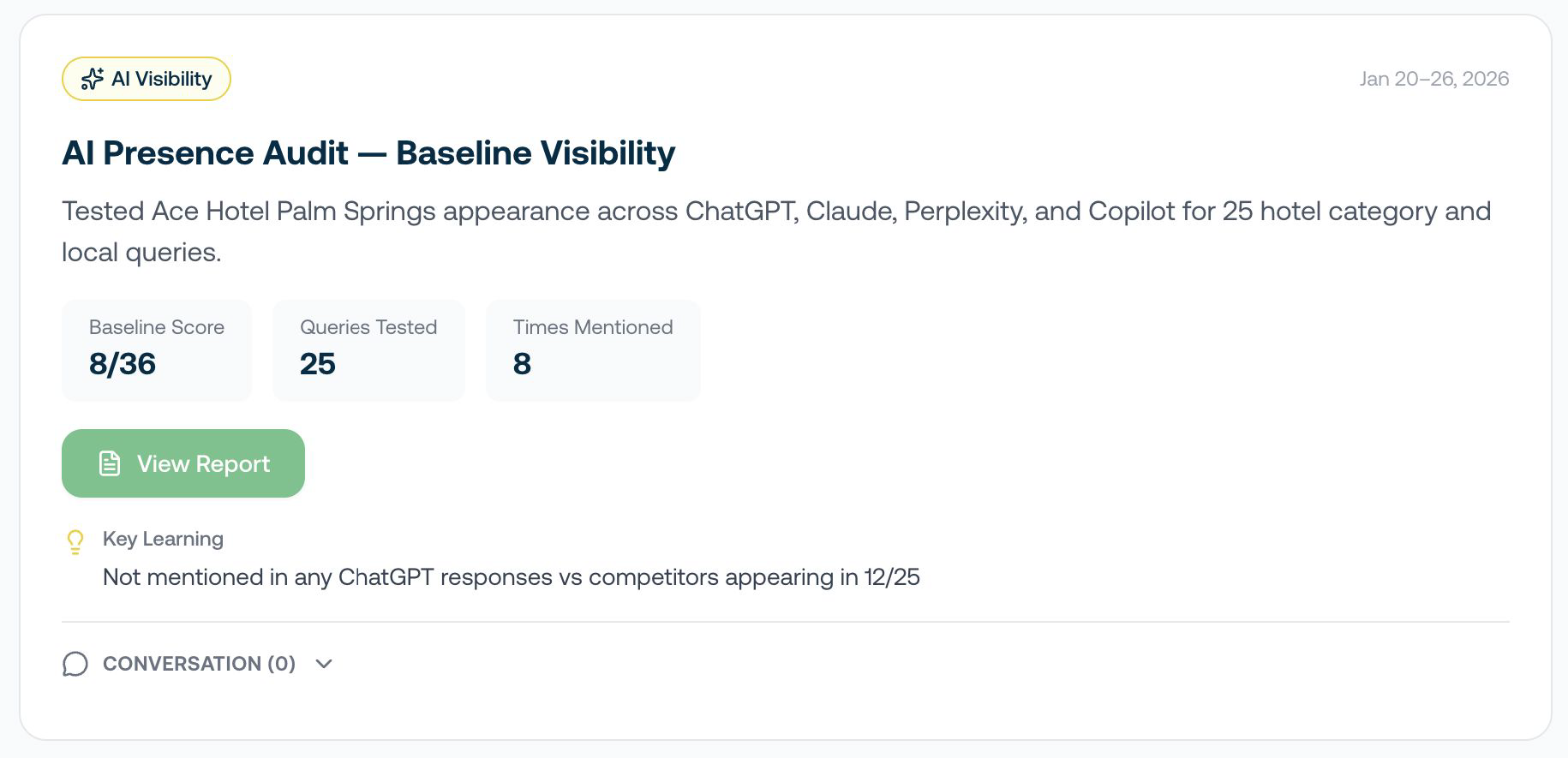
TakeUp Demand Generation AI presence audit, testing how a hotel appears across AI assistants.
AI visibility audit. Where the hotel shows up in AI answers.
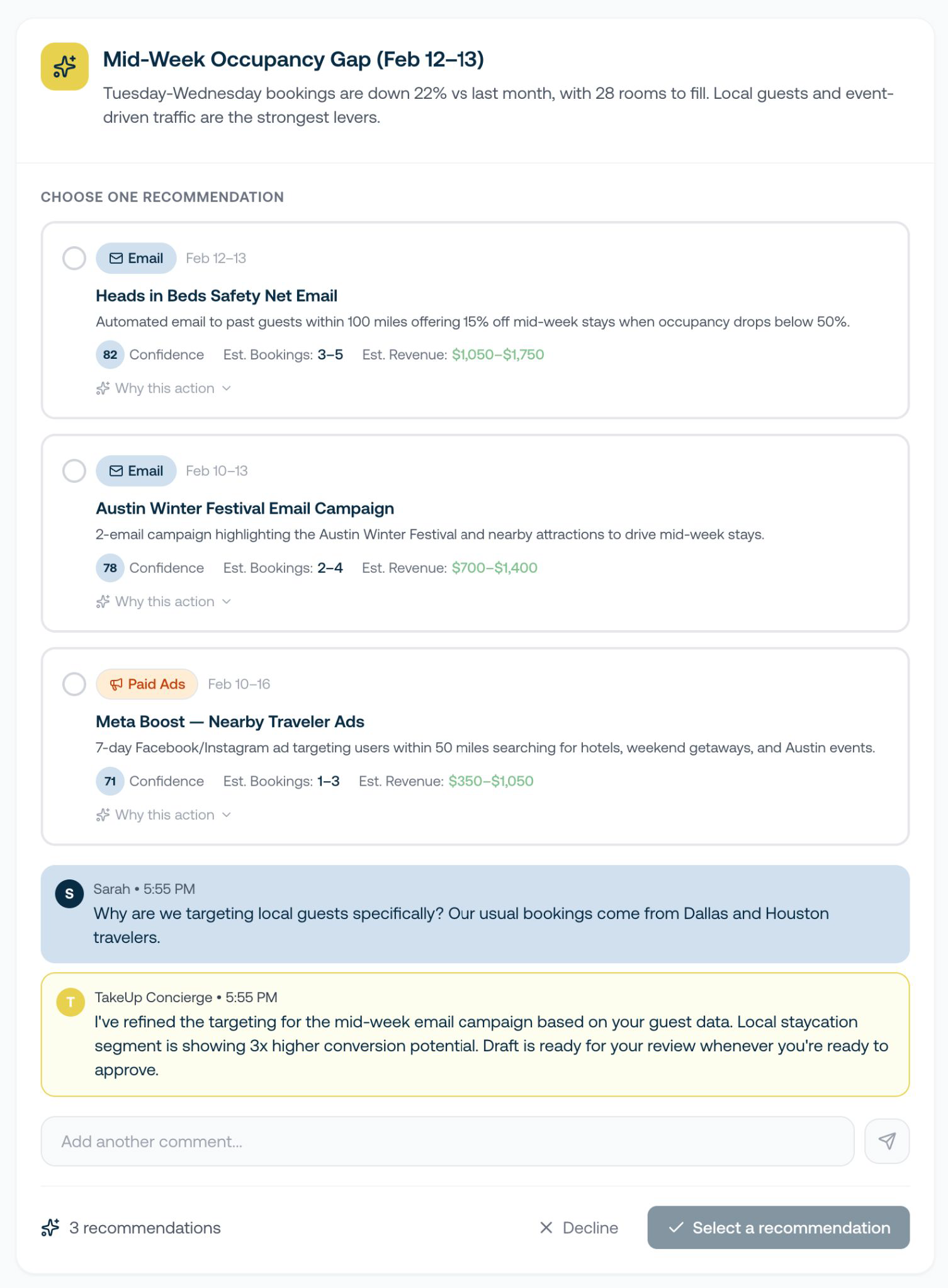
TakeUp Demand Generation concierge view: a flagged opportunity with ranked recommendations and a concierge conversation.
Opportunity review. Ranked recommendations the GM approves.
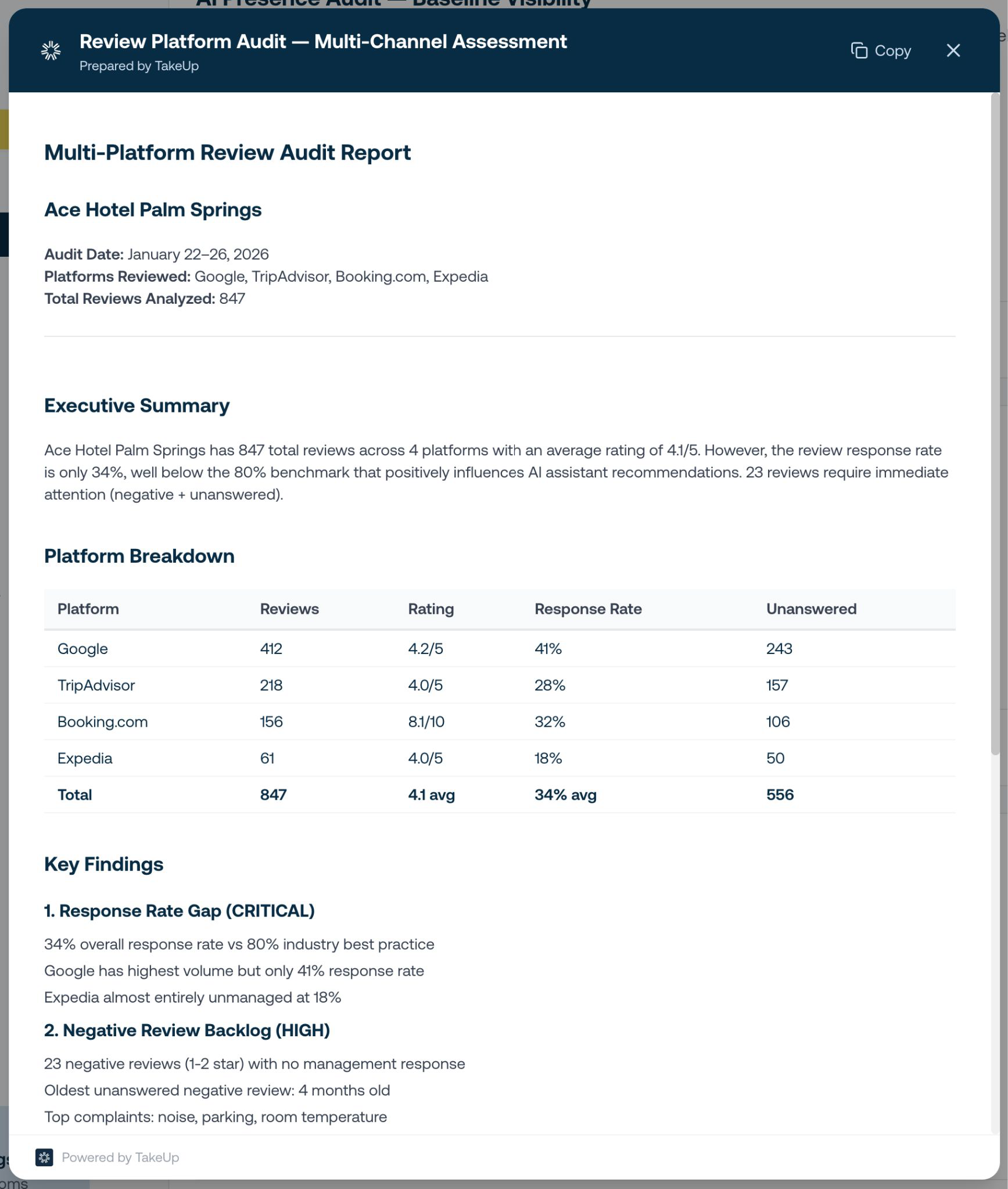
TakeUp Demand Generation multi-platform review audit report.
Review audit. Response gaps across every review platform.
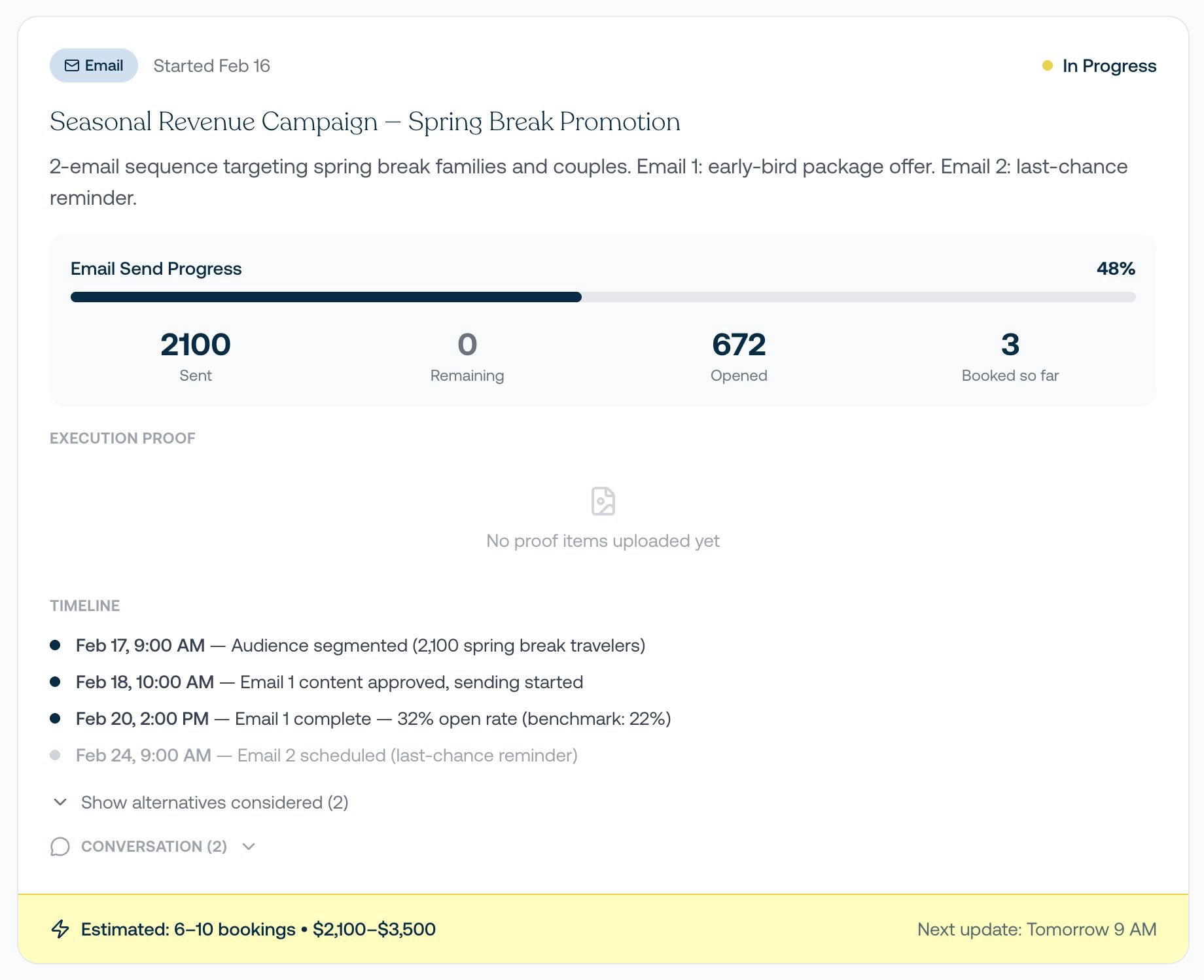
TakeUp Demand Generation campaign card with an execution timeline and proof of what ran.
Execution proof. What ran, when, and what it returned.
Fig. 1.4The Concierge console: AI visibility, opportunity review, audits, and execution proof.
TakeUp wound down. The way it was built, under a hard budget, is the way I still build.

Stryder

The strategic brain for the solo founder. Delivered daily over text. Grounded in each founder's actual data. Built solo, in public.

StryderSolo buildMay 2026 – presentIn development

Building a product just got easier; running a business didn't. Solo founders still fail for the reasons they always did: poor positioning, underpricing, and customer experience neglect, and beyond. So, I thought, what if we could help solo founders avoid common pitfalls and build thriving businesses? So, I built it just to show what I can do.

What Stryder refuses to be.

Stryder is a daily text message. No app, no dashboard, no login. That is a deliberate refusal. A dashboard with an alert for everything teaches a founder to ignore everything.

Stryder does the opposite: each morning it names the one thing worth acting on, and what to leave alone. The brief itself runs short: three to five ranked insights, each one what happened, what it means, and what to do.

Most of the product decisions were about what to leave out.

9:41
Stryder
Today 7:00 AM
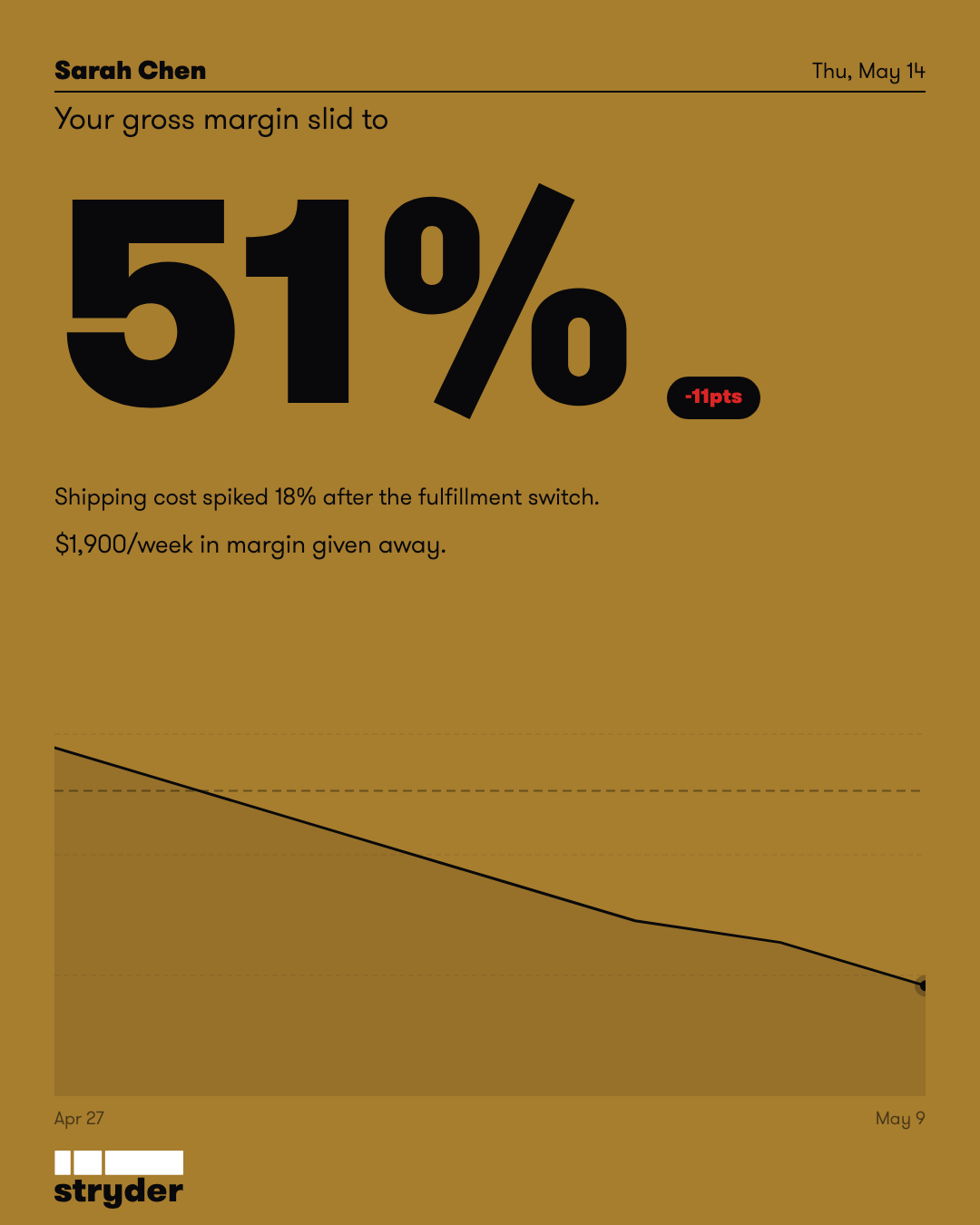
Stryder alert card showing gross margin compression from 62% to 51% with downward trend line
Your gross margin compressed from 62% to 51% over the past 30 days, and the cause is not pricing. Your shipping costs spiked 18% after you switched fulfillment partners last month. At your current order volume of 340/week, that is $1,900/week in margin you are giving away. The old fulfillment partner quoted you a return rate of $4.20/order vs. $5.80 you are paying now. This is fixable this week.
The margin hit is compounding. Your ad spend is calibrated to a 62% margin. At 51%, your ROAS target of 3.5x is actually yielding a contribution margin of 11% instead of 24%. Every ad dollar is working half as hard until the fulfillment cost is resolved.
Gross margin: 51% (was 62%, 30-day slide). Shipping cost per order: $5.80, up 38% since fulfillment switch. Weekly margin loss: $1,900. Ad contribution margin: 11% (was 24%).
You need to stop the margin bleed: 1 - Renegotiate with current partner (show them the old rate as leverage) 2 - Switch back to the previous partner this week 3 - Something else
2
Smart move. I will track your shipping cost per order daily this week and confirm the margin recovers by Friday.
How quickly will my ROAS recover once I switch back?
Based on your order cycle, you will see the first clean margin data in 3 to 4 days after switching. Your ROAS will not change, but your contribution margin per order will jump from $8.20 back to $18.60 immediately. At 340 orders/week, that is $3,536/week back in your pocket. No ad changes needed.
Text Message

Built to stay simple.

Two decisions shaped the build. Founders forward the reports they already receive and the system reads them, which removes a wall of integrations to set up. And each task is routed to the model that handles it best, with brief visuals rendered from templates rather than generated. Both decisions made the product simpler, not thinner.

Forwarded reportto morning briefStryder · solo build · the phone is the whole interface
Ingestion
4 channels
library pattern, not per-founder OAuth
+ EXPAND
Intelligence
4 LLMs, cost-routed
prompt orchestration
+ EXPAND
Strategy
per founder, living document
grounds every brief and response
+ EXPAND
Surface
phone = identity
SMS + MMS via Telnyx, no app
+ EXPAND
Founder behavior refines next-cycle prioritiesTap any station to expand
Fig. 2.1How a forwarded report becomes a grounded morning brief. Tap any stage to expand.

Built on the patterns that sink founders.

Before writing product code, I catalogued nine problems solo founders actually hit and twelve failure patterns that sink them, tested against businesses that failed in public. That work became eight principles the engine reasons with, plus five worked-example briefs I wrote end to end as design targets. The research is the part of the product that exists before the first user does.

9:41
Stryder
Today 7:00 AM
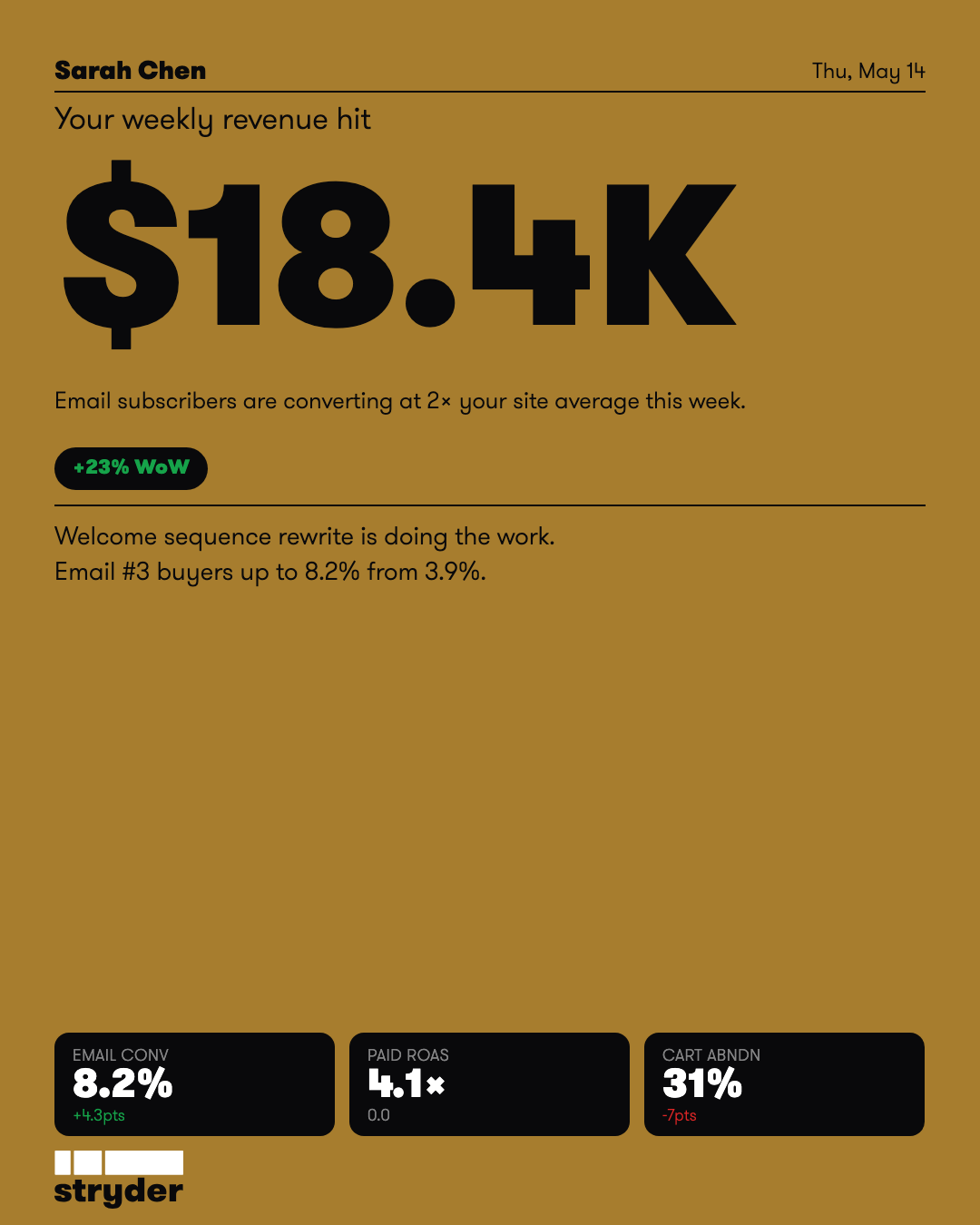
Stryder daily brief card showing weekly revenue of $18.4K, up 23% with sparkline trend and supporting metrics
Your email subscribers are converting at 2x your site average this week. That shift accounts for $3,800 of your $18.4K in revenue. The welcome sequence you rewrote two weeks ago is doing the work. New subscribers who hit email #3 are buying at 8.2% vs. 3.9% before. You are getting more revenue from the same traffic without spending another dollar on ads.
Here is what makes this durable: your paid acquisition cost held flat at $11.40 while email conversion doubled. That means your blended CAC dropped from $22 to $16. At your current margin, every new email subscriber is worth $47 in their first 60 days. Your list is now your best-performing channel.
Text Message

12failure patterns

  • Underpricing
  • Positioning confusion
  • Brand story calcifies
  • Founder avoids the business side
  • Tactical whack-a-mole
  • Customer experience neglected
  • Burnout from business over craft
  • Positioning and unit economics misaligned
  • The retail expansion paradox
  • Founder disengagement
  • Channel-strategy mismatch
  • Founder-product drift

8principles

  • Clarity cuts through bounded rationality
  • The right price anchors everything
  • Social proof and authority compound over time
  • Brand meaning is built through identity alignment
  • Salience beats reach
  • Movements grow through network effects, not ads
  • Stories work when the customer is the protagonist
  • Premium pricing improves perception if justified

5worked-example briefs

  • Strong week, a new growth engine firing
  • Revenue dip with a hidden opportunity
  • A competitor move
  • Launch preparation
  • Quiet week, but healthy

I built the backend too.

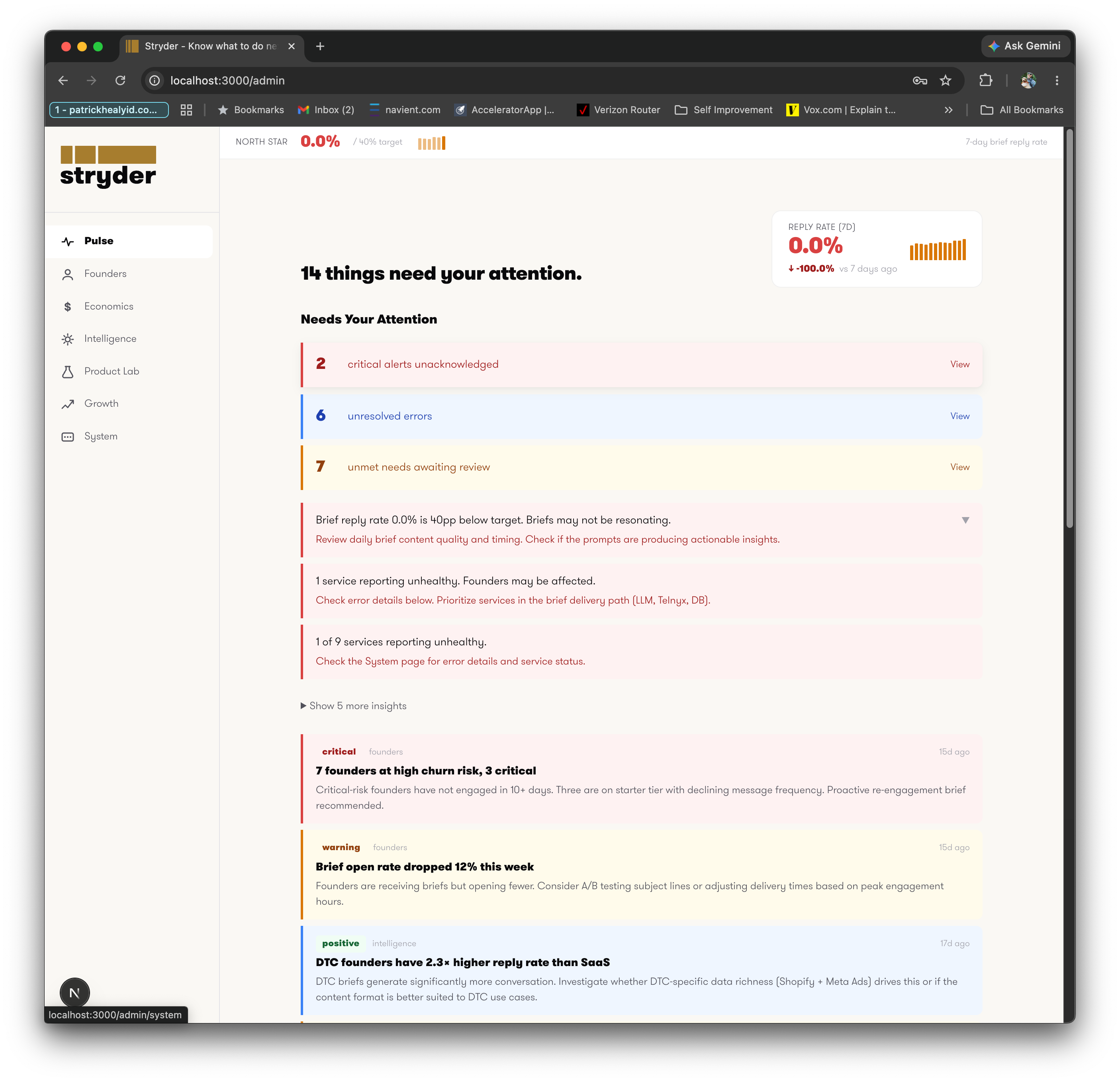
The founder-facing brief is only half of Stryder. The other half is the operator console I built to run it as a business, from churn risk on every founder to the cost of a single model call. It turns the product's own thesis, surface what matters and leave the rest alone, onto the company itself. Building the product is the easy half now. Building the business around it is the work I wanted to show.

Stryder operator console, Pulse view
Pulse
I built Stryder to show the work, not to wait for a first user. It is the clearest evidence I have of how I take a product from a sharp opinion to a built thing.

ServiceNow NowX

Defined & taught the product strategy framework as a trusted venture studio product operator inside a Fortune 500 SaaS company

ServiceNowStaff Product StrategistApr 2022 – Jul 20257 ventures, 1 graduated

NowX ventures
7
Graduated in three months
1
Strategists trained
120+
Fig. 3.1Seven NowX ventures. Accounts Receivable Support graduated in three months.

NowX was ServiceNow's internal venture studio, incubating new product lines inside a Fortune 500. I joined as a product strategist in April 2022 and stayed three years and three months. I was the only IC not expected to graduate with a product of my own. My job was to make the ventures that did graduate land.

Created and taught a framework for product strategy grounded in effective storytelling

Across the seven ventures, the recurring problem was not research or the insights. It was translating what we learned into the right product for ServiceNow. I developed a framework for turning insights into action through storytelling. I taught it across a three-section curriculum through ServiceNow's professional development program. Delivered live, then documented as a living resource that product operators leveraged as needed. The method reframed deliverables as the questions a venture actually had to answer to get funded or for product roadmaps to get approved.

Fig. 3.2The framework: ten features of a product-strategy case, grouped into a three-act arc.

How a studio bet actually graduates.

Accounts Receivable Support graduated by connecting ServiceNow's existing call-center footprint to a finance expansion, rather than by pitching a standalone product. Cross-org wedges like that one are how venture bets graduate inside a company that already ships a public product line.

Accounts Receivable Support graduated in three months. The method I taught became standard practice.

More

Iron Mountain · Corporate Innovation Labs

Product Lead, New Ventures · Jul 2021 – Apr 2022

Incubated three ventures in nine months, including a digital pathology platform positioned to become the world's largest biobank.

Tortuga Backpacks

Director of Product · Oct 2015 – Jun 2020

Designed the Outbreaker, Wirecutter's top carry-on pick for four years, and reframed Tortuga's category from functionality to identity. NPS 72.9 sustained over five years.

HeyLow

Founder · Apr 2020 – Jul 2021

Founded HeyLow, a sustainability-forward DTC menswear brand. Champions of the Weekend. Shipped the Out Of Office Button Down, reversible, UPF 50+, 86% post-consumer poly. Closed by founder choice in 2021.

Modern Industry

Founder · May 2011 – Sep 2015

Used my master's thesis to kickstart a premium, American made bag and clothing brand for grown up punks. Turned $5,000 into a $500K+ annual run rate, raised $130K+ across two Kickstarter campaigns, and walked away from a fundable institutional deal.

About

I am a strategic product leader who helps organizations identify and build the right AI-powered products from 0 to 1. By blending a human-centered, multidisciplinary approach with the latest AI development tools, I validate ideas and achieve product-market fit rapidly, delivering MVPs (Minimum Viable Products) entirely solo or as a team leader. After successfully incubating over a dozen ventures and driving products from a simple brief to signed design partners in months, I'm looking to bring my high-velocity building skills to my next startup role.